
Our story
Cory made the sealant he couldn't find.
It's a long trip down to Key West, even from Miami. Cory Boehne had been looking forward to riding his Onewheel there. Then he got a flat.
He went looking for a decent sealant in Key West. What he found sprayed straight back out of the puncture. That was the end of riding for that trip, and it put a damper on the whole thing.
Shop tire sealant
Why it started
He came home and got to work.
Back home, he put his years of manufacturing experience to work, along with his knowledge of chemistry and geology. He wanted to create the sealant he'd needed in Key West.
Personal electric vehicles ask a lot of small, delicate tires: mile after mile of hard riding on rough roads and gnarly trails. Cory wanted a sealant that could keep up.
His geology background helped him understand how particles of different sizes pack together and fill the spaces between them. He applied that same thinking to plugging a tire.
“I took what was out there, learned what works best, then just dialed everything up to the max and beyond.”
Cory Boehne, founder
Creating Armor-Dilloz
Start with what plugs the hole.
Cory studied the sealants already out there, learned what worked best and pushed the formula further. The key is the blend: different types and lengths of fibers, and rubber particles of different sizes and shapes, in just the right proportions.
The rest of the wheel matters, too. The formula includes anti-corrosives and is designed to tolerate repeated heating and cooling. Nobody wants to open an expensive device and find corrosion on the motor.
But it has to reach the hole. At lower speeds, Dilloz gathers at the bottom of the tire, where the tread meets the ground. As speed rises, it spreads around the tire. The fiber and rubber move with it, instead of staying stuck in one patch.
See the difference under the microscope
Made in the USA
The formula sets the process.
Packing fiber and rubber into a sealant is only useful if it makes it into your tire. That's why we make Armor-Dilloz in micro-batches, with equipment chosen and built around the formula.
Blades we sharpen by hand.
We use high-speed mixing equipment with blades we sharpen by hand to get the most from the formula.
All that material stays in.
We built our own filling system to handle the formula without filtering out fiber or rubber. We operate it by hand, one bottle at a time, so the blend we create is the blend that goes into your tire.
Even the way it changes inside the tire matters. The formula reaches its best performance after some time in use, as it breaks down a little.
 Watch the full test
No second take
A half-inch puncture. Then a ride. All on livestream.
Cory put a half-inch puncture into a Onewheel tire and went for a ride, all on livestream. No second take.
Watch the complete test, including the reinflation, refill and where the tire reached its limit.
About this test
Armor-Dilloz's full livestream, published June 30, 2020. We put a 1/2-inch puncture into a Onewheel tire on a public livestream, then took it for a ride. No second chance. No redo.
The test used residual stock sealant, changing dose after sealant loss and a refill, reinflation, and a reused puncture path. The street ride later ended with sealant discharge and Cory's call to replace the tire. Numeric post-ride pressure and the exact ride distance, duration, speed, and route are unknown.
Watch the original livestream on YouTube
Sealant can plug a puncture. It cannot rebuild a torn sidewall or a tire damaged by being ridden flat. See the full setup and test timeline.
Beyond the bottle
Still out there with you.
We sponsor and support riders, events and local crews because we love being part of this community. We also help photographers capture it, with gear and training that gets more people behind the lens.
Cory still brings his camera, too. The races, the group rides, the friends you make along the way: those are the things a bottle of sealant is there to help you enjoy.

Made for your next ride
Put Dilloz in your tires.
Red is our highest level of protection, recommended at 30 mph or less. Blue is our pick above 30 mph, and a great choice below it too. Green costs less per fill, especially on larger tires.
Shop tire sealant Find the amount for your tire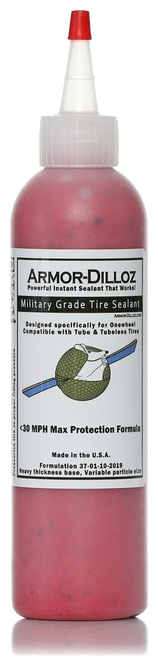 Red
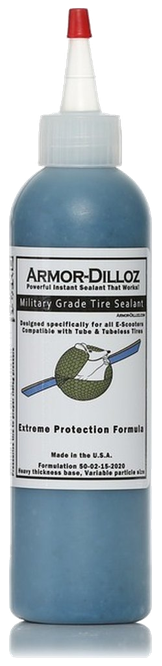 Blue
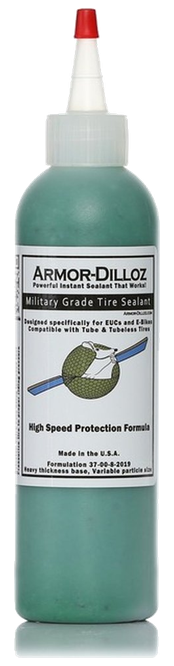 Green
Your tire takes the same amount of Red, Blue or Green.