View screenshot
I have since ridden over 100 miles on the Dillo, and the tire hasn't lost a burp of air.
After a staple puncture and an unsuccessful repair with another sealant, Sean added Red and took his board back out.
Why Armor-Dilloz
A big puncture needs more than liquid.
Look at Red under the microscope: more fibers, longer strands and larger rubber particles than the two competitors shown. We refined that mix to plug big punctures, while keeping it free to flow where it's needed.
Look inside.
Red has more fibers, longer strands and larger rubber particles than the two competitor samples shown here. The dense web in Red contrasts with their smaller, scattered particles and far fewer visible fibers. We refined this mix of lengths and sizes to form a strong plug.


Red is Armor-Dilloz. The green consumer sample and blue premium sample are two anonymous competitors, not our Green and Blue formulas. Select a photo to see the original.
Fiber and rubber do the plugging. The liquid gets them there. Armor-Dilloz keeps that material moving toward escaping air so it can collect at the puncture and form a plug.
We mix at high speed with hand-sharpened blades to get the most from the formula. Our custom filling system handles one bottle at a time without filtering out fiber or rubber. Made in the USA.
It has to get to the hole.
At lower speeds, Dilloz gathers at the bottom of the tire, where the tread meets the ground. As speed rises, it spreads around the tire. The fiber and rubber move with it instead of staying fixed in one patch.
A sealant fixed to the casing gives a puncture only the material already nearby. Building that coating takes more sealant, and if it shifts, it can affect balance. Dilloz stays free-flowing so fiber and rubber can move toward escaping air. The right dose leaves enough liquid moving inside the tire.
Choose Red at 30 mph or less, Blue above 30 mph, or Green for a lower-cost fill.
No second take
Watch the full test
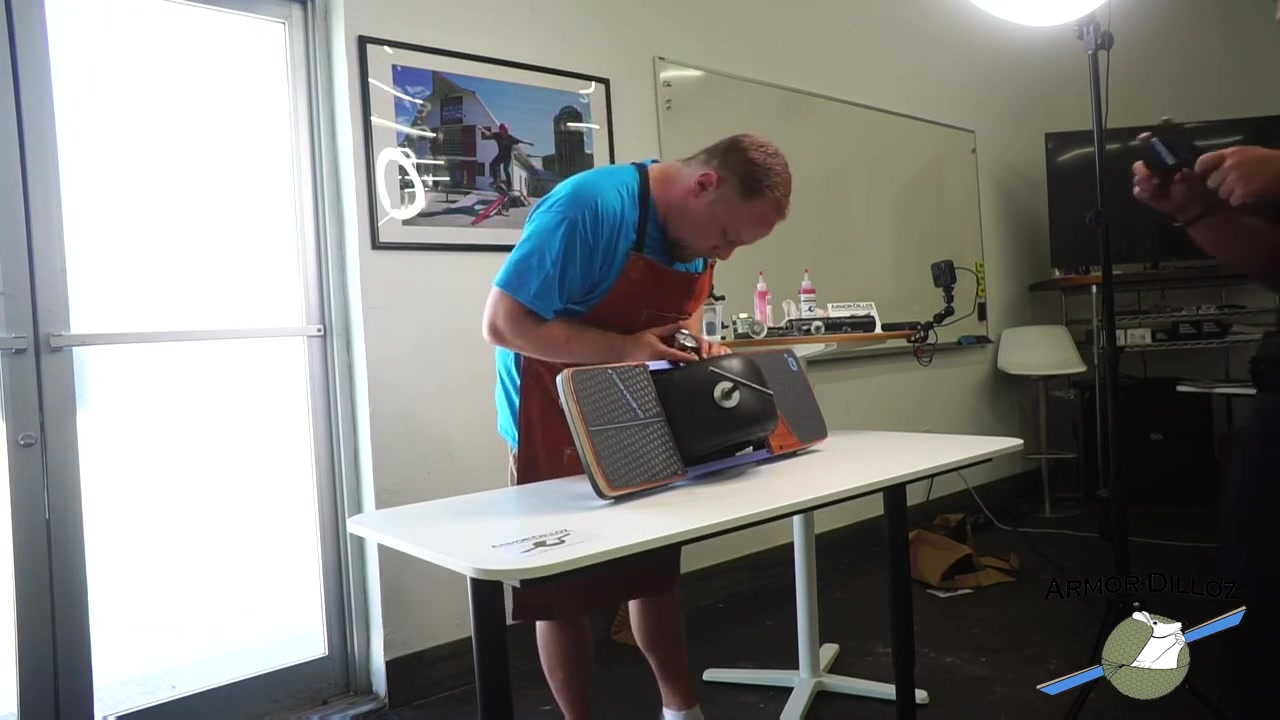
We put a half-inch puncture into a Onewheel tire and went for a ride, live on stream, with no second take.
This is our own demonstration on a stock Onewheel XR tire, with Red added over remaining stock sealant. It is not a controlled head-to-head test.
Watch the test and read the rider storiesIn our full test recording, we use a newly unboxed Onewheel XR and stock Vega tubeless tire. Red was installed over residual stock sealant. One nominal full bottle was installed. After sealant loss and the first blowout, another bottle was added, the tire was reinflated, and the same puncture path was reused.
Cory identifies the puncture as half an inch. The street ride ended with discharge and a replace-the-tire warning; there is no numeric post-ride pressure, and the exact ride distance, duration, speed, and route are unknown. Because the tire already contained another sealant, the dose changed and the same puncture path was reused, this is not a controlled head-to-head test.

Back out riding
Sean took his board back out after a staple puncture. David pulled a nail, put air back in and went riding with his kids. These are their own words.
View screenshot
I have since ridden over 100 miles on the Dillo, and the tire hasn't lost a burp of air.
After a staple puncture and an unsuccessful repair with another sealant, Sean added Red and took his board back out.
View screenshot
did about 20 miles round trip and came home and still inflated perfectly.
David removed a nail and reinflated his Cycleboard's tube tire before heading out with the kids.
These are Sean's and David's results. Tire condition, damage, dose and pressure all matter. More stories from boards, bikes, EUCs and scooters.
One simple speed rule
Most protection at 30 mph or less
Our highest level of protection. Choose Red at 30 mph or less, whatever you ride.
We don't recommend Red above 30 mph.
Shop RedAbove 30 mph
Blue gets as close to Red's protection as we can make it, with easier flow and extra-long fibers for inner tubes. Our pick above 30 mph, and a great choice at lower speeds too.
Shop BlueAny suitable air-filled tire
Our value pick for any suitable air-filled tire, especially a larger tire that needs more sealant.
Shop GreenFind the amount for your tire. Already have sealant inside? The installation guide covers adding to an existing fill. If you cannot identify the old sealant, follow the tire and sealant makers' removal and cleaning instructions before refilling.